
Traceability That Starts in the Fields: How Better Module Tracking Drives Gin Efficiency
The cotton industry has long recognized the need for reliable module tracking. But for gin operators, the question isn’t just about traceability—it’s about efficiency. When modules arrive with missing or unreadable tags, operations slow down. Manual intervention becomes the norm rather than the exception. Yard management becomes guesswork.
It doesn’t have to be this way.
The Hidden Cost of Manual Tag Management
In the traditional manual process, producers attach tags provided by the gin, which are then collected at the module feeder. This process is entirely dependent on manual management—and that’s where things break down.
We’ve observed typical rates of 1-5% of modules arriving with missing tags. Some gins report rates significantly higher. Every missing tag means someone has to stop what they’re doing, track down information, and manually reconcile records. Multiply that across thousands of modules per season, and the inefficiency compounds quickly.
The push toward “tag-less” systems isn’t new. The industry has recognized this problem for years.

The Standard Approach: Better, But Still Disruptive
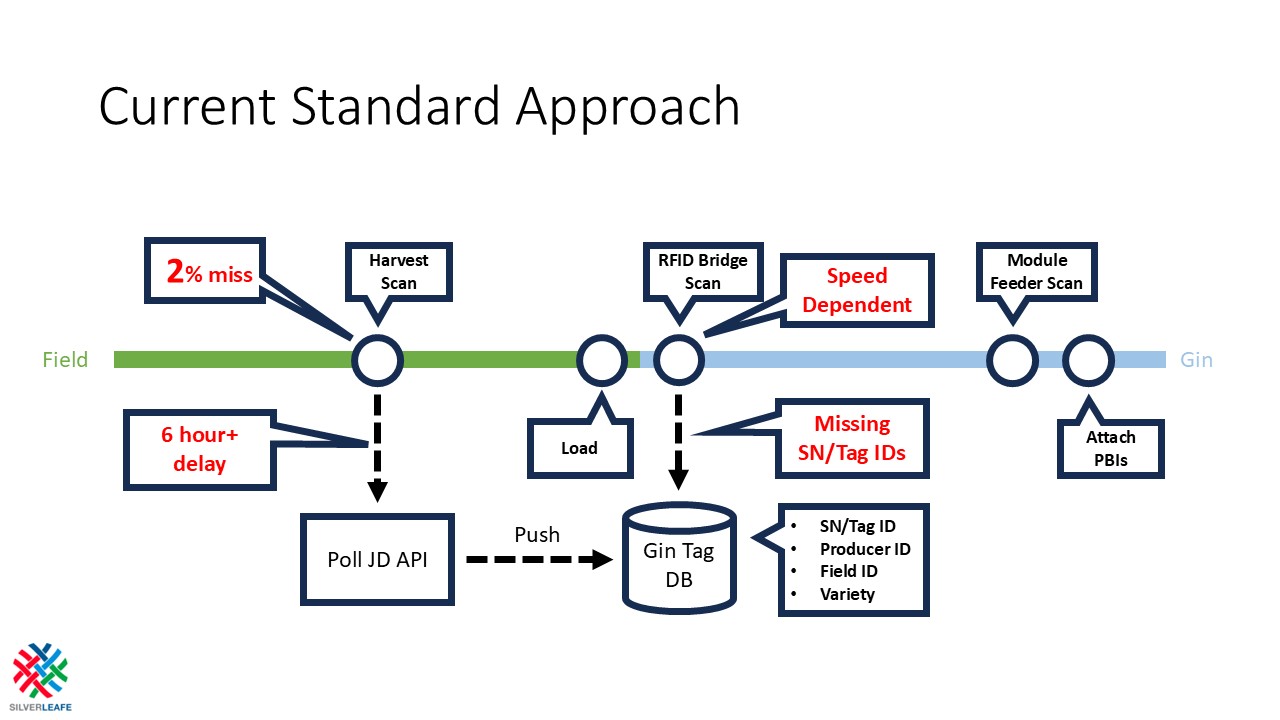
The most common modern approach works like this: John Deere harvesters record module data in Ops Center, gins poll that API to populate their database, and modules pass through an RFID bridge scanner on arrival. In theory, this should work.
In practice, it creates operational headaches.
Based on multi-year data correlated with gin arrivals, there’s approximately a 2% miss rate in reading module tags at the harvester. If modules pass through the RFID gate too quickly, additional tags go unread. The variability means multiple modules per load can arrive without data.
Then there’s the delay problem. A 6-hour lag is typical before harvest data becomes available via the API—multi-day delays aren’t uncommon. Throughout the day, loads arrive with modules showing as “missing” in your system, requiring manual intervention to sort out.
For gin operators, this means:
- Constant interruptions to reconcile missing module data
- Yard management challenges when you don’t know what’s sitting where
- Delayed processing decisions waiting for data to catch up
- Labor tied up in manual lookups instead of productive work
Maximizing Scan Opportunities for Operational Confidence
The key insight is straightforward: to maximize the chances of reading an RFID tag, you need to maximize scanning opportunities. Rather than relying on a single scan at harvest—or hoping the bridge scanner catches everything—we add multiple scan points before modules even arrive at your gate.
We add scans when:
- Modules are loaded onto a trailer or module truck
- Modules are unloaded at the gin
Each scan meets or exceeds the success rate of the harvest scan alone. Combined, they push read rates above 99.9%.
The unload scan is particularly valuable for gin operations. It has lower variability than the bridge scan because it doesn’t depend on how fast a driver moves through the gate. By the time a module hits your yard, you already know what it is, where it came from, and what variety it contains.

What This Means for Your Operation
With reliable data arriving in real-time, gin operations change fundamentally:
Yard management becomes proactive. You know what’s on each trailer before it’s unloaded. You can direct modules to appropriate locations based on producer, variety, or processing priority—not scramble to figure it out after the fact.
Manual reconciliation drops dramatically. Instead of chasing down 2-5% (or more) of modules with missing data, you’re dealing with exceptions measured in fractions of a percent.
Processing decisions happen faster. When data arrives with the cotton—not hours or days later—you can make informed decisions about scheduling and sequencing without waiting.
Labor focuses on value-added work. The time your team currently spends on manual lookups and tag management can shift to activities that actually improve throughput.
The Bottom Line
| Approach | Tracking Rate | Data Availability |
| Current Standard | ~98% tracked | Delayed (6+ hours) |
| Integrated Approach | >99.9% tracked | Real-time/near real-time |
Moving from 98% to 99.9% might sound incremental. In practice, it’s the difference between a system that requires constant manual intervention and one that runs smoothly. It’s the difference between reactive yard management and proactive operations.
The technology exists. What’s needed is an integrated approach that captures data at multiple points—passively—and delivers it when you need it: before the cotton arrives at your gate.
This article is based on a presentation delivered at the 2026 Beltwide Conference. For more information on improving gin efficiency through better module tracking, contact Silverleafe.